| OK.
Let's talk about the basics or some things to consider from the
start. The bass horn will be discussed here as it poses the most
problems and the worst one is that of size. The low frequency
limit determines the length of the horn and the mouth size; the driver
determines the throat size and back chamber loading. So, a larger
driver will require a larger chamber and throat but the horn will be
slightly shorter. On the other hand, a smaller driver will require
a smaller chamber and throat but the horn will be longer. The
above is assuming the low frequency limit is the same in both cases.
A straight axis bass horn in
a house, unless it a very large house, is out of the question so one has
no alternative but to fold the horn. Still, the mouth size will be
large as will the length. Let's consider a bass horn with a
desired low frequency limit of 40 Hz. With a 15 inch driver, the
throat will come out to about 88 sq, in., although that can be reduced
to a little more than half that with the application of a few
modifications to the whole design called multiple flaring. That
too will be discussed later.
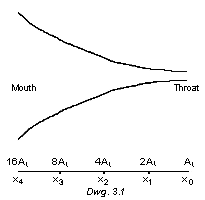 |
A very
general view of a straight axis horn showing the flare from
throat to mouth. In the scale at the bottom, the distance x
is the length along the axis in which the cross sectional area
doubles, at x1
to x4.
At
is the throat area and 2At
at x1
is twice that area. The progression is continued until the
required mouth area is obtained. |
It is considered that the
mouth diameter be equal to half the wavelength of the lowest frequency
to be reproduced, the cutoff frequency. The term diameter is used
as a reference to the area as the mouth can be square or rectangular
which is preferable for wood construction for obvious reasons. So,
in this case we have a mouth diameter of 169 in. which equates to 155
ft^2 which is about 12 ft. on a side, if square. Big, isn't
it? Under certain conditions, that can be halved but it's still
large with it's 8.8 ft. sides.
The total length of the horn
will be about 12.4 ft. Even folding it or twisting it around the
driver chamber in a sort of spiral, like a snail's shell, won't help as
the mouth is still too darn large. Keep in mind that this is pure
theory and applies to horns used in large areas like outdoors or large
auditoriums. When the theory is applied to small rooms as in a
house, certain compromises can be made as well as taking advantage of
architectural properties of rooms, such as the corner.
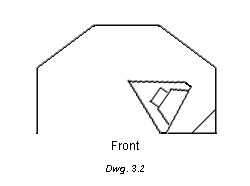 |
Dwg.
3.2 shows one way of folding a horn that was popular in the
50's. The low frequency response was good to about 60 Hz.
below which the horn had progressively less effect and the
efficiency dropped rapidly. |
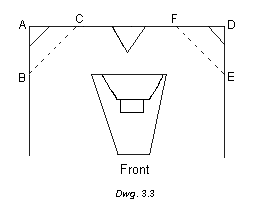
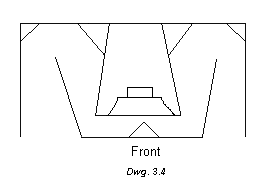
Below are two
more designs using a twin path instead of one. A note in passing;
in the three drawings, 3.2, 3.3 & 3.4, the view is from the top.
 |
 |
| In the
above dwg. 3.3, the corners can be truncated at BC and EF to
allow the horn to be placed into a corner. This will give
the advantage of the reflections from the walls and floor.
The effect will allow the mouth of the horn to be reduced in
size by a factor of 8. Still, the path is short and low
frequency output will deteriorate. Below cutoff, the unit
will act similar to a direct radiator in a corner. (see note
below) Despite this, once taken into the confines of a
room, where horn theory at very low frequencies is no longer
applicable, horns can exhibit astounding
performance. This is mainly due to the
transient response and low distortion above cutoff where a horn will far surpass the best
closed box and bass reflex (vented) systems.
Without the corners truncated
and with an upper section containing the squawker and tweeter,
the unit becomes the Belle Klipsch®, a design from
Klipsch & Associates. |
The
design shown above in dwg. 3.4 has often been referred to as a
"W" or "M" horn by musicians; the choice of
nomenclature depending upon whether the designator is in front
of or behind the system. It offers the advantage of a
longer path at the compromise of a larger unit. |
| Note
It
should be remembered that a horn is a wave guide. The
theory is simply to guide the sound wave from the mouth of the
horn in a specified direction. Outside or in very
large areas this is necessary as one wouldn't desire the sound
to go where there isn't an audience. At frequencies where
the wavelength is large as compared to room dimensions, the
boundaries of the room negate the need and function of the
waveguide, For instance, in a room with dimensions of 17
by 20 (feet)and with an 8 foot ceiling, the longest dimension
(diagonally) is 27 ft. and corresponds to a 41 Hz.
wavelength. Below this, the room boundaries take
over. Actually, the length, width and height have
even more effect than the diagonal. In the room described
here, for instance, two of the dimensions are very close to a
2:1 ratio, an acoustical taboo. The room itself is an
integral part of what we hear from any loudspeaker system but
unfortunately it is usually ignored. The loudspeaker,
amplifiers and even the connecting wire take the blame for
unsatisfactory sound reproduction in the form of sales
hype. |
Chapter
4
Horn Theory - Chapter Index
|