SLOB/SLPP
Slot Loaded Open Back / Slot Loaded Push Pull
| This project was stimulated by a friend, prior to which I had but a vague awareness of its existence. Several years ago, a friend gave me a book titled, Question Everything which was true of my nature which has its root when I was a kid. My dad taught me how to think, not what to think.
|
| PHOTO 1
The chamber. It measures 11"x9.625"x1.5" for a volume of 189 cubic inches. This includes the added volume (12 in^3) of the slot in the yet to be attached front baffle and the combined volumes of the frusta of the two speaker cones. (18 in^3) The slot area is 16.5 in^2 The larger chamber including the frusta and the slot volume is 274 in^3 |
|
| PHOTO 2
The front baffle attached. It serves little enhancement of the low frequencies as it's longer dimension, 25" will support frequencies above about 500hz. This size was chosen because it fits the 3 ft^3 enclosure upon which it sits and can be used for future tests. |
|
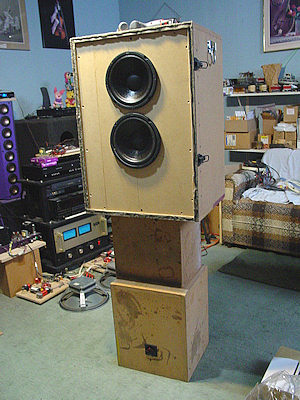
| PHOTO 3
The assembly mounted on top of another enclosure to get the center of the slot midway between the floor and the ceiling, 48 inches. the CLIO is internally calibrated to cancel first reflection from the floor and ceiling with the mic at a distance of 1m from the source. The LMS allows adjustment of these distances and once entered, it will turn off the signal before the first reflection gets to the mic, thus simulating an anechoic response. Both units will fail below about 400hz as the wavelength is too long to get a good sample before the reflection arrives. |
|
| PHOTO 4
This was a later experiment to see what happens if the chamber volume were increased by 80in^2 by increasing the chamber width by 0.75 inch. There were two tests done here. One with the wider slot and another, shown here, with the slot reduced to the original size and both with the larger chamber. The results were unworthy of consideration and therefore, not reported here. (see fig 2) It seems the chosen volume may be close to optimum. Consideration was given to making the chamber smaller but that has yet to be studied. The main purpose of this experiment was to determine if second harmonic distortion is reduced, as claimed.
|
|
| PHOTO 5
The speakers in a sealed box of 3 ft^3. Second harmonic distortion was lower than that of the slot system and, obviously, the lower bass was enhanced due to the blocking of the rear wave. |
|
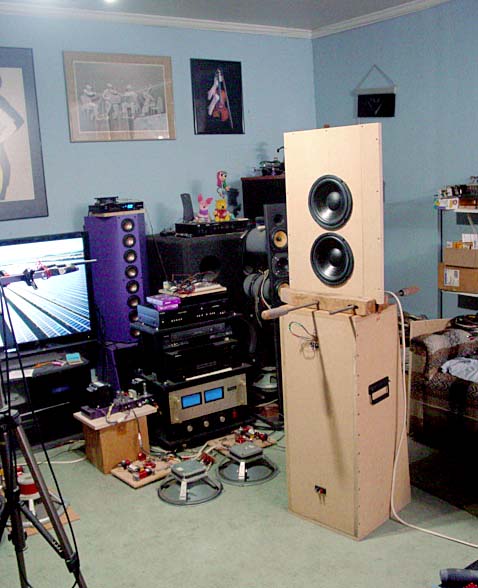
| PHOTO 6
The two eights on an open back baffle, |
|
| FIGURE 1
Z BLK=2 in parallel in SLOT Chamber; RED=2 in parallel in 3 cu ft sealed At first glance, it may seem counterintuitive that fs would be lower with the pair facing each other in a small chamber. The rear of the speakers is radiating into open space, unlike the pair in the closed box. Despite the fronts of the speakers radiating into a small space, that space is open at the slot and while it may impose a heavier load on the speakers, the speakers may see it as additional mass, hence the lower resonant point. The open back imposes a far less load than the 3 ft^3 sealed box thus resembling an open air condition. The open air resonant point of these speakers is 32hz and in the SLOB, that resonant point has lowered to about 29hz, very likely due to the effect of the air load in the slotted chamber being pushed by one speaker against the other The "blips" at about 170hz and 340hz are nor floor bounces as both speakers were measured in the same location and under the same conditions. They may be due to reflections from the back wall as they only show during the open back sweep. See the note at the bottom of this page. |
|
| FIGURE 2
1w1m big box is 79 in^3 larger and its slot is area is 24.75 in^2 Its slot volume adds 18 in^3 to the chamber. RED=small box small slot ORN=2nd harmonic GRN=big box big slot BLU=2nd harmonic BLK=big box small slot GREY=2nd harmonic It seems that there is little effect with the above combinations although the small box with the small slot has less 2nd harmonic distortion below 230hz |
|
| FIGURE 3
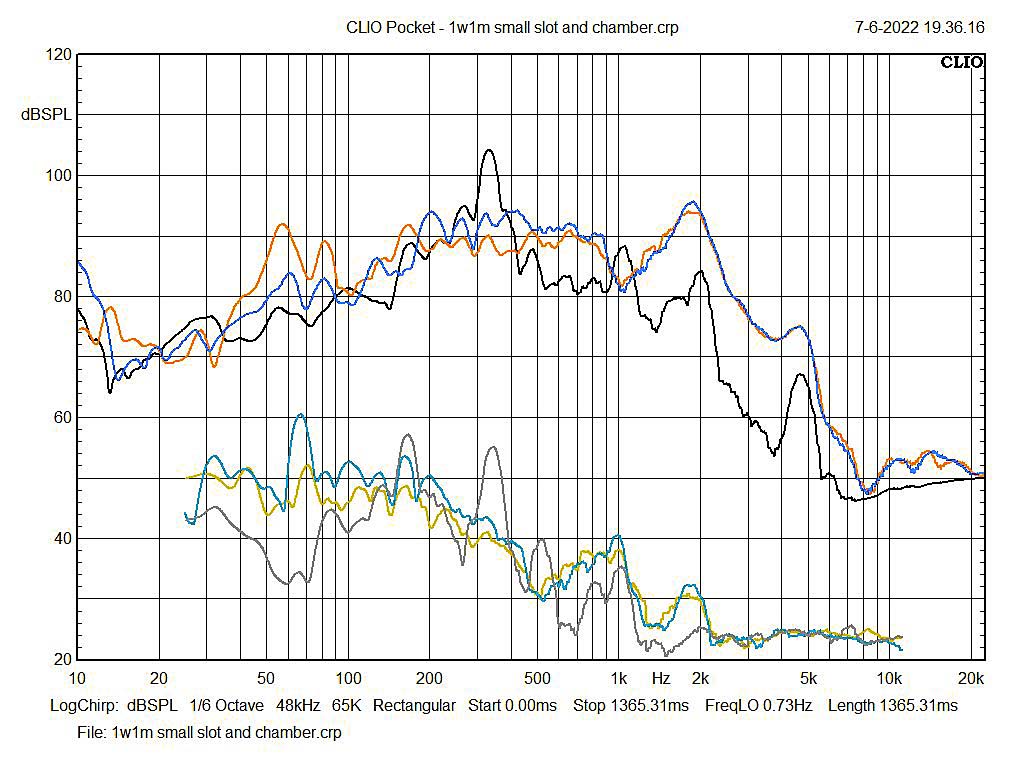
1w1m small slot and chamber RED=THD GREEN=2nd harmonic; ORANGE=3rd harmonic This shows that the total harmonic distortion is mostly 2nd harmonic Fig 4 shows the same comparison at 10 watts |
|
| FIGURE 4
10w1m GREY=small slot and chamber RED=THD GREEN=2nd harmonic; ORANGE=3rd harmonic The major result of the 10 watts is an increase in response level by 10dB, which was expected.. What wasn't expected was the distortion components not increasing more than 10dB. |
|
| FIGURE 5
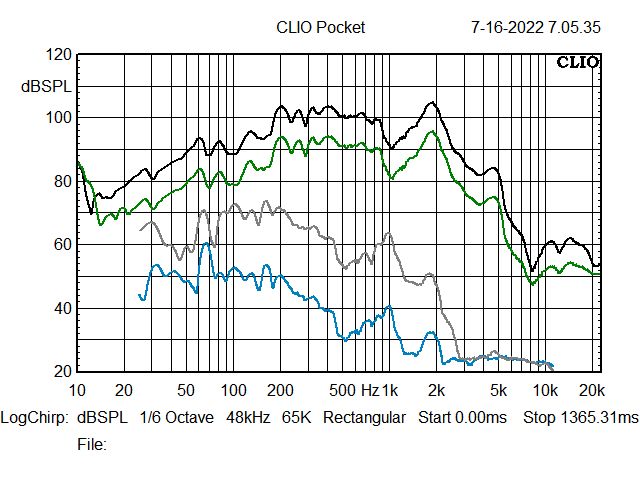
10w1m GREY=3 cu ft sealed YEL=2nd harmonic RED small slot and chamber ORN=2nd harmonic Comparison between the two eights in a closed box(GREY) with its 2nd harmonic(YELLOW) and the SLOB(RED) with its 2nd harmonic(ORANGE) In their passbands below 500hz, the closed box has much less 2nd harmonic distortion than the SLOB, contrary to claims of the opposite. Keep in mind that the response below 150hz or so is affected by the room hence the higher bass output of the closed box. |
![]() |
The note at the bottom of this page (FIGURE 8A & 8B)
Air has a mass of 1.12kg/m^3 or 0.0184g/in^3. The 189 in^3 chamber contains 3.469g of air, which is 1.734g/speaker. This increase in mass attached to the cone will show a lower resonant point in an impedance sweep.
LMS was used here because it has certain features that the Pocket CLIO doesn't have. The more sophisticated CLIO probably does but it costs about $3000.
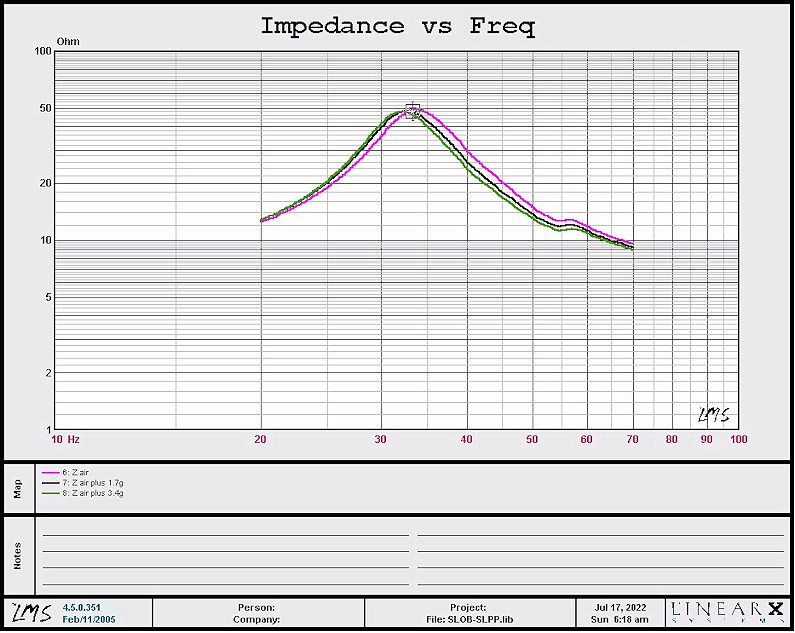
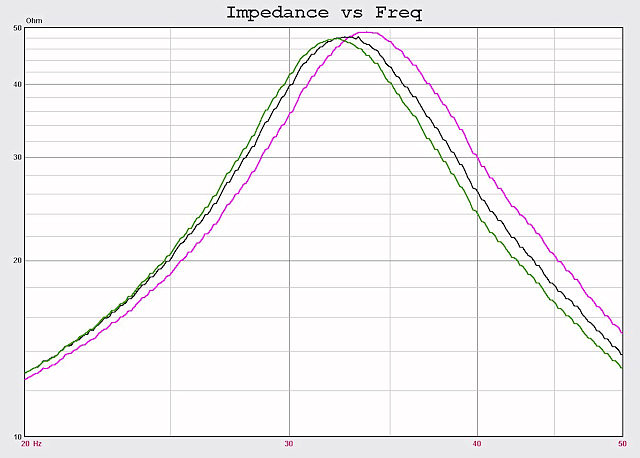
The LMS will allow a start and stop point to be selected with as much as 800 data points. This sample was swept between 20hz and 70hz with 300 data samples. This allows a much more accurate point of resonance to be located using the cursor (not shown), which can move from one data point to the next using the left and right arrow keys. Here, we have a resonant point at 33.345hz with an impedance peak of 48.206W (BLACK) with 1.7g added to the cone. The PINK trace is the impedance without the added mass and peaks at 33.736hz with an impedance peak of 49.169W The GREEN trace is the impedance with 3.4g added and has a resonance at 32.245hz with an impedance of 47.875W
What has all this to do with second harmonic distortion? Probably little to nothing but my curiosity had to be satisfied, despite the veracity of the above. If nothing else, it was better than nothing, a shot in the dark.
The LMS doesn't perform distortion and spectrum analyses; CLIO does.

An enlargement of the above.

Back to the loudspeaker main page